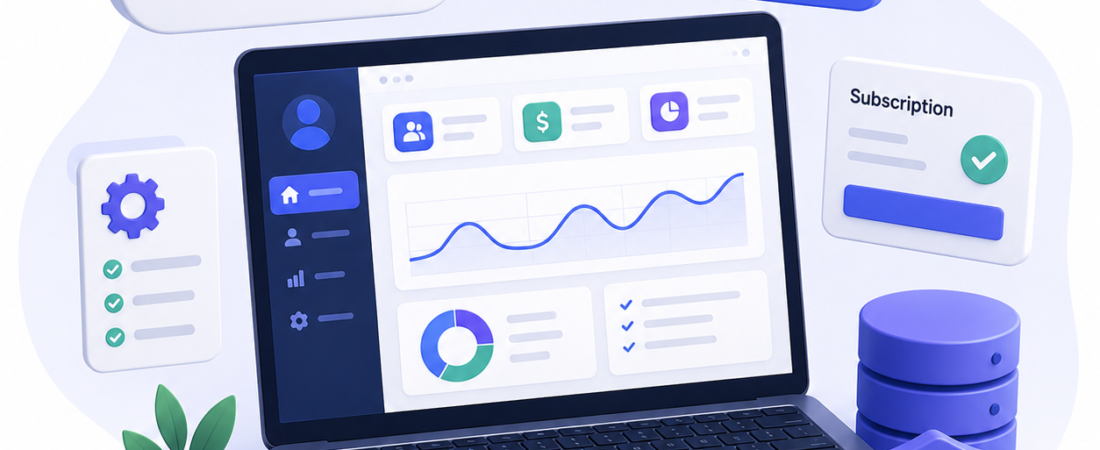
Building a SaaS (Software as a Service) product is one of the best ways to turn an idea into recurring revenue. But many SaaS products fail not because the code is bad, but because they solve the wrong problem, launch too late or can’t scale when customers arrive. This guide walks through how to build a SaaS product step by step, from validating the idea to launching and growing it.
1. Validate the problem before writing code
Every successful SaaS product starts with a painful, frequent problem that people will pay to solve. Before you design screens or choose a tech stack, confirm that the problem is real.
- Talk to 15–20 potential customers. Ask how they solve the problem today, what it costs them and what frustrates them most.
- Study competitors. Existing competitors are a good sign: they prove there is a market. Look for gaps in their pricing, features or customer experience.
- Test demand. A simple landing page with a waitlist or a pre-order offer shows whether people care enough to act.
If people describe the problem in their own words without being prompted, you have found something worth building.
2. Define your MVP (minimum viable product)
An MVP is the smallest version of your product that solves the core problem well enough that early users will use it, and ideally pay for it. The goal is to learn fast, not to build everything.
- List every feature you have in mind, then mark only the ones needed to solve the main problem.
- Cut “nice to have” features such as advanced reports, integrations and custom themes for later releases.
- Write simple user stories, for example: “As a clinic manager, I want to book appointments online so that I spend less time on the phone.”
A focused MVP reaches the market sooner, costs less and gives you real feedback to guide the next release.
3. Plan the SaaS architecture
SaaS products have technical needs that ordinary websites don’t. Getting the architecture right early saves expensive rebuilds later.
Multi-tenancy
Most SaaS platforms are multi-tenant: many customers (tenants) share the same application while their data stays separate and secure. You can isolate tenants with a shared database and a tenant ID on every record, a separate schema per tenant, or a separate database per tenant. The right choice depends on your security needs, customer size and budget.
Authentication and roles
Plan for secure sign-up, login, password reset and, for business customers, team accounts with roles and permissions (owner, admin, member). Single sign-on (SSO) is often requested by larger customers.
Subscriptions and billing
Recurring billing is the heart of SaaS. Payment platforms such as Stripe handle subscription plans, free trials, upgrades, invoices and failed payments, so you don’t have to build billing from scratch.
Cloud infrastructure
Cloud platforms such as AWS, Microsoft Azure and Google Cloud let you start small and scale as you grow. Containers (Docker) and orchestration (Kubernetes) make deployments repeatable and help the application handle more users without downtime.
4. Choose a practical tech stack
There is no single “best” stack. Choose proven technologies your team can support for years. A typical modern SaaS stack includes:
- Frontend: React, Next.js, Vue or Angular for a fast, responsive web app.
- Backend: Node.js, Python (Django or FastAPI), PHP (Laravel), Java or .NET.
- Database: PostgreSQL or MySQL for core data, with Redis for caching.
- Infrastructure: AWS, Azure or Google Cloud, with Docker and a CI/CD pipeline for automated testing and deployment.
5. Design for the user, not just the feature list
SaaS customers can cancel any month, so usability directly affects revenue. Good UI/UX design reduces support requests and helps new users reach value quickly.
- Create wireframes and clickable prototypes before development starts.
- Design a simple onboarding flow that gets users to their first success within minutes.
- Keep dashboards focused on the few numbers each user actually needs.
6. Build in short, agile sprints
Agile development breaks the project into short sprints, usually one to two weeks. At the end of each sprint you review working software, collect feedback and adjust priorities. This keeps the project on track and avoids surprises at launch.
7. Test thoroughly before launch
Bugs in a subscription product cost you customers. Plan for:
- Automated tests for core logic, billing and permissions.
- Security testing for authentication, data isolation between tenants and common vulnerabilities.
- Performance testing to make sure the app stays fast as users and data grow.
- Beta testing with a small group of real users.
8. Launch, measure and improve
Launch is the beginning, not the end. After going live, track the metrics that show whether your SaaS is healthy:
- Monthly recurring revenue (MRR) and its growth rate
- Churn rate: the share of customers who cancel each month
- Customer acquisition cost (CAC) and customer lifetime value (LTV)
- Activation rate: how many sign-ups reach their first success
Use these numbers, along with customer feedback, to decide what to build next.
Common mistakes to avoid
- Building too many features before talking to customers
- Ignoring security and data isolation in a multi-tenant system
- Building billing yourself instead of using a proven payment platform
- Choosing a stack only because it is trendy
- Launching without analytics, so you can’t see what users actually do
How long does it take to build a SaaS product?
It depends on the scope. A focused MVP with core features, user accounts and subscription billing is much quicker to build than a full platform with integrations, mobile apps and advanced reporting. The fastest way to get a reliable estimate is to define your MVP clearly, then plan the work in phases.
Build your SaaS product with StackTrio
StackTrio helps founders and businesses turn ideas into scalable SaaS platforms, from MVP planning and UI/UX design to multi-tenant architecture, subscription billing, cloud deployment and ongoing support. Explore our SaaS product development services, see examples in our portfolio, or contact our team to discuss your idea.